
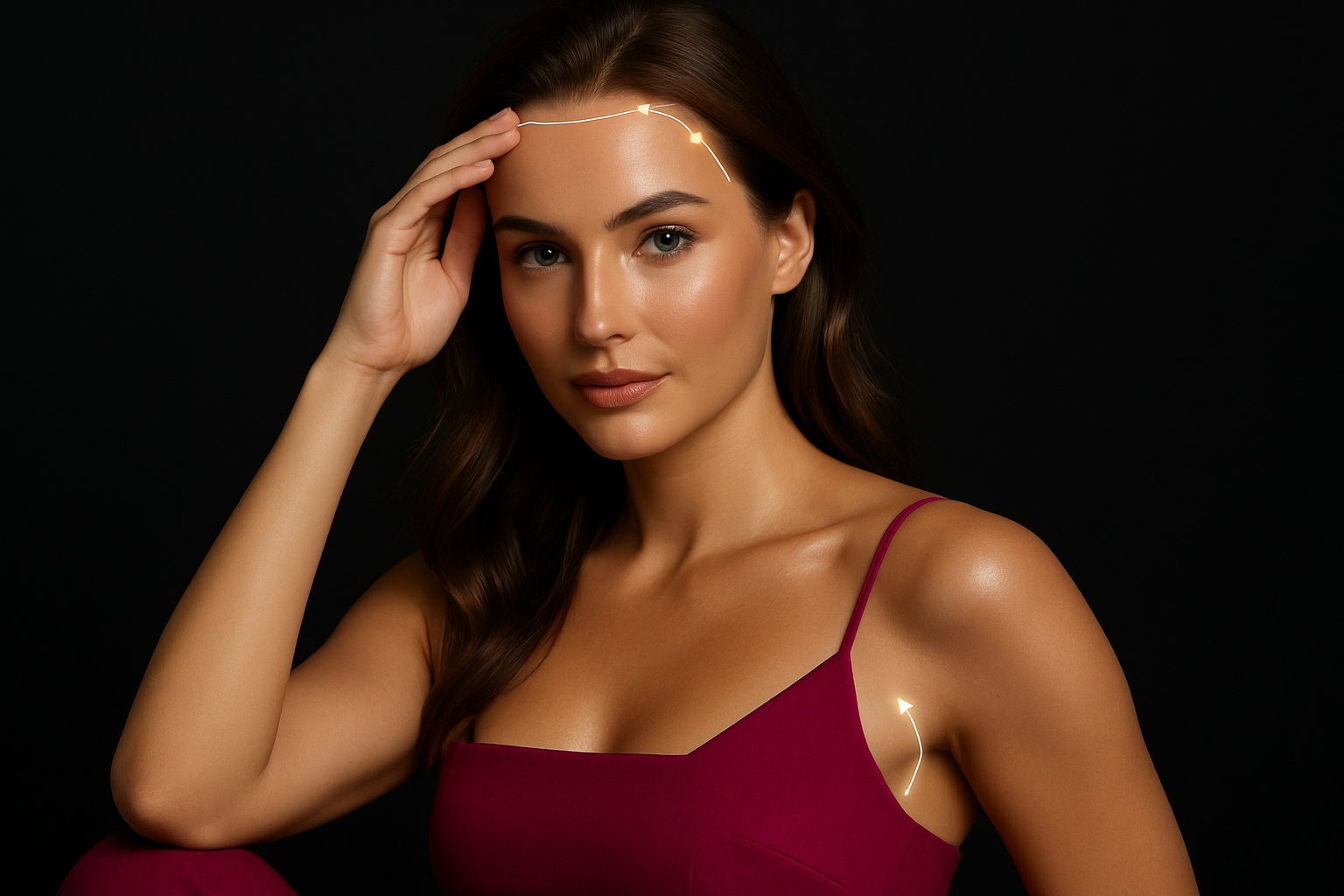
Facial aesthetic balance is largely dictated by the rule of horizontal thirds: the upper third (forehead), middle third (midface and nose), and lower third (chin and jawline) should ideally share equal proportions. When an unusually high anterior hairline or overly prominent forehead disrupts this equilibrium, it can make the upper face appear disproportionate and detract from overall facial soft tissue harmony. Forehead reduction surgery, medically known as hairline lowering or hairline advancement, is a specialized cosmetic procedure designed to shorten the upper facial third by advancing the scalp forward.
Table of Contents:
- Quick Medical Facts Summary
- Procedure & Treatment Overview
- Ideal Candidates & Medical Assessment
- Modern Surgical Techniques & Technologies
- Step-by-Step Procedure Process
- Recovery Timeline, Aftercare & Expected Results
- Global Cost & Destination Comparison
- 5-Day VIP Patient Journey in Istanbul
- Frequently Asked Questions (FAQ)
- Summary & Next Steps
Patients seeking this operation frequently express concerns regarding visible scarring, facial nerve integrity, and long-term scalp sensation. At Health & Beauty Turkey, our board-certified craniofacial and plastic surgeons utilize advanced trichophytic incision techniques to ensure that hair follicles grow directly through the surgical scar line, yielding an imperceptible outcome. By integrating specialized surgical planning with international patient care, Turkey has established itself as a premier destination for complex facial plastic procedures.
Quick Medical Facts Summary
| Procedure Name | Forehead Reduction Surgery (Surgical Hairline Lowering) |
|---|---|
| Average Surgery Duration | 1.5 to 2.5 hours |
| Anesthesia Type | General Anesthesia or Deep Sedation |
| Hospital Stay | 1 Night (Overnight Monitoring) |
| Initial Recovery Time | 7 to 10 days (Suture removal at Day 7) |
| Final Aesthetic Outcome | 6 to 12 months (Scar maturation and hair regrowth) |
| Clinical Success Rate | 98% patient satisfaction rate |
Procedure & Treatment Overview
Forehead reduction surgery physically advances the natural hair-bearing scalp to reduce the vertical distance between the eyebrow arches and the frontal hairline. Unlike hair transplantation, which redistributes individual follicular units over several months to build density, surgical hairline lowering produces an immediate, substantial reduction in forehead height—typically between 1.5 to 3.0 centimeters in a single stage.
For patients considering comprehensive upper face rejuvenation, understanding the difference between simple scalp advancement and combined structural procedures is essential. Depending on individual tissue dynamics, some patients benefit from combining hairline advancement with eyebrow repositioning. Detailed insights into combined modalities can be reviewed in our analysis of forehead reduction in Turkey and integrated aesthetic strategies.
Ideal Candidates & Medical Assessment
Not every patient presenting with a high forehead is a suitable candidate for surgical hairline lowering. A meticulous preoperative physical examination and clinical assessment are critical to confirm candidacy and prevent post-surgical complications such as wound dehiscence or scalp necrosis.
- Scalp Laxity: The single most important anatomical requirement is adequate scalp mobility. Patients with supple, pliable scalp tissues allow for maximum forward advancement without undue tension on the incision line.
- Stable Hair Density: Candidates must possess dense, stable frontal hair growth. Individuals with active, progressive androgenetic alopecia are generally poor candidates, as subsequent hair loss would expose the underlying surgical scar.
- Facial Proportions: Individuals with a high natural hairline from birth, rather than male-pattern hair thinning, benefit most dramatically from this procedure.
- Absence of Active Scalp Conditions: The surgical field must be free from active psoriasis, severe seborrheic dermatitis, or folliculitis.
Modern Surgical Techniques & Technologies
Modern facial plastic surgery has evolved far beyond basic skin excision. Today’s surgical methodologies prioritize tension-free closures, micro-vascular preservation, and concealed incisional scarring.
1. The Irregularized Trichophytic Incision
Rather than executing a straight linear incision, the surgeon performs a micro-bevelled, irregularized cut directly along the frontal boundary of the hair follicles. By cutting the skin at an oblique angle relative to the hair shafts, the underlying hair follicles are preserved beneath the wound edge. As healing progresses, natural hair shafts grow directly through the scar tissue, rendering the scar virtually invisible to close inspection.
2. Subgaleal Dissection and Mobilization
The surgeon dissects within the loose subgaleal plane beneath the scalp’s subgaleal fascia, extending far back toward the posterior scalp. This extensive mobilization permits the entire hair-bearing scalp to slide forward seamlessly over the pericranium without compromising the blood supply delivered by the supraorbital and supratrochlear arterial branches.
3. Endtine and Bone Fixation Systems
To eliminate tension at the skin edge, specialized bio-absorbable fixation anchors (such as Endotine devices) or precise pericranial sutures are anchored into the outer table of the frontal bone. This internal fixation bears 100% of the mechanical traction, allowing the skin edges to sit together without any pulling force, which is the key to preventing widened scars.
4. Combination Approaches
In cases where severe brow ptosis coexists with a long forehead, surgeons can seamlessly incorporate brow lift maneuvers. For non-surgical alternatives or minor corrections, patients may evaluate surgical and non-surgical forehead lift options to determine which approach aligns best with their anatomical goals.
Step-by-Step Procedure Process
- Preoperative Surgical Marking: While the patient is seated upright, the surgical team meticulously charts the proposed new hairline, ensuring symmetrical alignment with facial bony landmarks and accounting for dynamic muscle movement of the frontalis muscle.
- Anesthetic Administration: The patient is placed under general anesthesia. Local anesthesia containing epinephrine is injected along the surgical pathway to minimize intraoperative bleeding and optimize surgical visualization.
- Incision and Dissection: The delicate trichophytic incision is created along the marked anterior hairline. Dissection proceeds deeply into the subgaleal plane, releasing the galeal aponeurosis posteriorly to achieve maximum scalp elasticity.
- Advancement and Anchoring: The scalp complex is drawn forward over the underlying pericranium to meet the newly designed hairline mark. Internal absorbable sutures or bio-anchors secure the galeal layer firmly to the deep pericranium.
- Precision Excision and Skin Closure: Excess non-hair-bearing forehead skin is excised cleanly along the pre-planned line. The superficial dermal and epidermal layers are meticulous closed in multiple tension-free layers using ultra-fine suture materials.
- Dressing Placement: A sterile compressive head dressing is applied to prevent sub-galeal hematoma formation and minimize immediate swelling.
Recovery Timeline, Aftercare & Expected Results
Understanding the postoperative healing phase empowers patients to manage their recovery comfortably and maintain realistic expectations throughout the healing trajectory.
- Day 1 to Day 3: Moderate forehead swelling and periorbital bruising may develop. The surgical dressing is typically removed or changed on Day 2. Patients must sleep with their head elevated at a 45-degree angle to accelerate lymphatic drainage.
- Day 7: Superficial cutaneous sutures or surgical clips are routinely removed. Mild temporary numbness in the anterior scalp is normal due to nerve traction and resolves over several months.
- Weeks 2 to 4: Swelling dissipates significantly. Most patients comfortably return to social activities and non-strenuous computer-based work within 10 to 14 days post-op.
- Months 3 to 6: Hair follicles that were transected during the trichophytic cut begin to sprout through the surgical scar line. Fine sensory nerves gradually re-innervate the anterior scalp.
- Months 6 to 12: The surgical incision matures from a faint pink line into a pale, hidden scar completely integrated within the natural hairline. Final aesthetic balance is established.
Global Cost & Destination Comparison
Turkey has established a dominant global presence in facial plastic surgery by offering board-certified surgical expertise, accredited medical infrastructure, and comprehensive VIP logistics at transparent pricing models.
| Country / Destination | Average Cost (USD) | JCI Accreditation Standards | Travel & Logistics Experience | All-Inclusive VIP Care Package |
|---|---|---|---|---|
| Turkey (Health Beauty Turkey) | $2,500 – $4,200 | World-class / Highest Density of JCI Hospitals | Seamless VIP Transfers & 5-Star Hotel Included | Yes (Full Surgical & Logistics Concierge) |
| United States | $9,000 – $16,000 | High | Patient-managed travel & accommodation | No (Separate billing for facility & anesthesia) |
| United Kingdom | £6,500 – £11,000 | High | Patient-managed travel & accommodation | No (Additional fees for follow-up visits) |
| Germany | €7,000 – €12,000 | High | Patient-managed logistics | No (Standard clinical billing) |
| Thailand | $4,500 – $7,000 | Moderate to High | Tourism-focused packages | Rarely includes full VIP transportation |
| India | $3,000 – $5,000 | Variable | Complex travel arrangements | Varies by clinic |
5-Day VIP Patient Journey in Istanbul
To ensure total comfort and peace of mind for our international guests, Health & Beauty Turkey organizes a seamless 5-day surgical experience.
- Day 1: VIP Arrival & Luxury Transfer: Upon landing at Istanbul Airport, our private driver meets you at the terminal and escorts you in a luxury VIP vehicle to your 5-star hotel. You can relax and prepare for your consultation.
- Day 2: Clinical Consultation & Surgery Day: You are transported to our JCI-accredited hospital for blood work, baseline ECG, and deep clinical consultation with your operating plastic surgeon. The hairline is precisely drawn and agreed upon, followed by the surgery. You remain overnight in a private suite for surgical observation.
- Day 3: Hospital Discharge & Early Rest: Following morning rounds, your surgeon inspects the incision and removes the primary surgical dressing. You are cleared for discharge to your 5-star hotel with prescribed medications and soft-tissue care protocols.
- Day 4: Rest & Personal Leisure: A dedicated day for quiet recovery in comfort. Patient coordinators remain in constant communication to monitor your pain control, swelling, and fluid intake.
- Day 5: Suture Removal, Final Evaluation & Return Flight: You return to the clinic for final evaluation, suture removal (or check if absorbable), hair washing under medical supervision, and post-operative instructions. Your private driver then escorts you to the airport for your flight home.
Frequently Asked Questions (FAQ)
Will forehead reduction surgery leave an obvious visible scar?
When performed by an experienced plastic surgeon utilizing the advanced irregularized trichophytic incision, the scar becomes virtually undetectable over time. Hair shafts grow directly through the healing tissue, concealing the scar along the boundary of your natural hairline.
Can I combine forehead reduction with other facial surgeries?
Yes. Hairline lowering is frequently combined with secondary facial balancing procedures. Many patients opt to perform a brow lift or secondary upper blepharoplasty simultaneously. For candidates examining eye and brow procedures, reviewing our brow lift vs eyelid surgery comparison provides clear diagnostic guidance.
What is the difference between forehead reduction surgery and hair transplantation?
Forehead reduction surgery is an immediate surgical advancement of the intact scalp that lowers the hairline by 1.5 to 3 cm in a single procedure. Hair transplantation involves grafting individual hair follicles over 8 to 12 months, which requires multiple sessions to achieve comparable dense coverage on a broad forehead.
How long must I wait before returning to intense exercise?
Light walking is encouraged immediately after surgery to promote blood circulation. However, strenuous physical exercise, heavy weightlifting, swimming, and activities that elevate blood pressure significantly must be avoided for at least 3 to 4 weeks to prevent post-operative bleeding or incisional stretching.
Summary & Next Steps
Forehead reduction surgery provides a permanent, highly effective surgical solution for individuals seeking to reduce upper facial height and achieve symmetrical facial harmony. By combining advanced trichophytic incision methods, internal tension-reducing fixation, and comprehensive international patient care, Health & Beauty Turkey delivers exceptional surgical outcomes in the heart of Istanbul.
If you are considering surgical hairline lowering and would like a professional anatomical assessment of your scalp laxity and prospective forehead height, we invite you to connect with our clinical consultation team. Our board-certified plastic surgeons will review your photographs and medical history to design a personalized treatment plan tailored to your aesthetic goals.
Medical Disclaimer: The content provided in this article is intended strictly for educational and informational purposes and does not constitute formal medical advice, diagnosis, or treatment plans. All surgical procedures carry inherent risks, including but not limited to infection, scar hypertrophy, temporary nerve paresthesia, and bleeding. Always seek the advice of a qualified, board-certified plastic surgeon or licensed healthcare provider regarding any specific medical condition or surgical treatment options.
Related Articles: forehead reduction in Turkey | surgical and non-surgical forehead lift options | brow lift vs eyelid surgery comparison
References & Trusted Sources: National Institutes of Health (NIH) – Clinical Research | World Health Organization (WHO) – Health Guidelines | National Center for Biotechnology Information (NCBI / PubMed)